
Another newsletter from the Locarno Film Festival. August, for me, is a month devoted to cinema. But this second Locarno newsletter isn't about the Pardo d'oro winner Florin Șerban. It's about the political weight of cinema—with an interview with Ehsan Khoshbakht, curator of this year's retrospective: Red & Black: Hollywood Left and the Blacklist.
Politics is a powerful lens through which to read cinema in general, and film festivals in particular. The idea of a film festival wasn't born out of love for cinema as an art form. It was born as political propaganda. The first film festival in the world opened in Venice in 1932, and it was an instrument of Fascist cultural policy, with a side benefit for the hotels—tourism is still a main force behind festivals, only now propaganda has been replaced by diplomacy.
In 1938 the main prizes, both named "Coppa Mussolini," went to Luciano Serra, Pilot, an Italian war film produced under the supervision of Mussolini's son, and to Olympia, Leni Riefenstahl's documentary on the 1936 Berlin Olympics, made in association with the Nazi propaganda ministry—a masterpiece of cinema, but also an apologia for Nazi values. The French delegation walked out and started planning a rival event in Cannes, conceived as the democratic answer to a festival with a clear totalitarian aim (the jury's decisions are widely suspected of having been directly influenced by the Duce and the Führer). The war postponed this new festival, and Cannes finally opened in 1946—the same year Venice returned, in a liberated Italy. Karlovy Vary, in what was then Czechoslovakia, began that year too, and would become the socialist bloc's shop window. But the most explicitly political festival was Berlin, which came in 1951, launched with American backing near the Soviet sector to show East Germany how wonderful the American way of life was.
Locarno's first steps follow the Venetian track—a story reconstructed by the historian Cyril Cordoba in Désaccords à Locarno, a political history of the festival from 1946 to 1991, on which I rely for what follows. In September 1941 a festival of Italian films opened in Lugano, picking up the Venice selection, run by a distributor the federal police would later file as a fascist sympathizer. The tone faded in 1944, but in 1946 the event was given up because the townspeople voted down the open-air arena planned in the lakeside park, and without a venue the organizers handed it to Locarno. Here a tourist board improvised a festival in a few weeks, with the aim of stretching the tourist season into late August. Like Venice and Cannes, the first Locarno Film Festival stood for the reconstruction of Europe and the reconciliation of peoples. But the paths of Venice and Locarno would separate very soon.
Locarno faced the highly cartelized film distribution system present in Switzerland and the lack of support by a Swiss government that didn't want to upset other countries by giving the impression it was trying to compete with their festivals. So Locarno couldn't invite foreign producers through diplomatic channels, and it had no official competition, which the Swiss distributors and exhibitors didn't want anyway. Both gaps counted against it when the FIAPF, the international federation that ranked festivals, came to judge. In 1954 the federation put Cannes and Venice at the top, Berlin and San Sebastián just below, and relegated Locarno to the bottom category, the one reserved for festivals of merely national scope.
And when the Swiss importers quarreled with international producers over rental prices, the producers boycotted Locarno: Hollywood, which had supplied about a fifth of the program in the festival's early years, largely stopped sending anything worth showing. The 1956 edition was canceled and, in order to continue, Locarno turned to the films it could actually get, which came from the other side of the Iron Curtain.
We can read this repositioning in two ways. Locarno as a place of freedom, where in neutral Switzerland you can watch movies that for political reasons are not distributed in the West. Or Locarno as a place where cinephiles were blind to the propaganda risks of eastern cinema. That second reading is the interpretation of the German-speaking Swiss press, which began accusing the festival of having been sold to the East and threatened a campaign against it. The campaign worked: in 1960 the jury, unanimous in favor of a Soviet film—Foma Gordeev by Mark Donskoy—was "convinced" to award it only the Silver Sail instead of the Golden Sail. The film found no Swiss distributor until 1965.
The critics' frame was simple: eastern films were mainly ideology and only secondarily art, while western films were cinema driven by artistic intentions or by commercial evaluations, but in any case not propaganda. That assumption was naive, and the retrospective of this year's Locarno Film Festival shows how problematic it was: politics was a main ingredient in both western and eastern cinema, but with different flavors. After the war, both cinemas were pushed by state policy.
For western countries the policy changed once the war was over, because the Soviets were no longer a useful ally against Germany. So in 1943 Hollywood made The North Star, a film sympathetic to the Soviet ally, encouraged by the Roosevelt administration—and a few years later that same film had become a problem. The American embassy in Tehran asked a local cinema to drop its North Star retrospective and screen something with a less dated message instead.
In the East, cinema had to hold the line of communism and Soviet values. In the West, after the war, films had to be a shop window for the magnificence of the free market economy. And this was a problem for the many progressive impulses that wanted to improve American society—because if you need to improve something, it means there are flaws. And admitting those flaws was collaboration with the Soviet enemy.
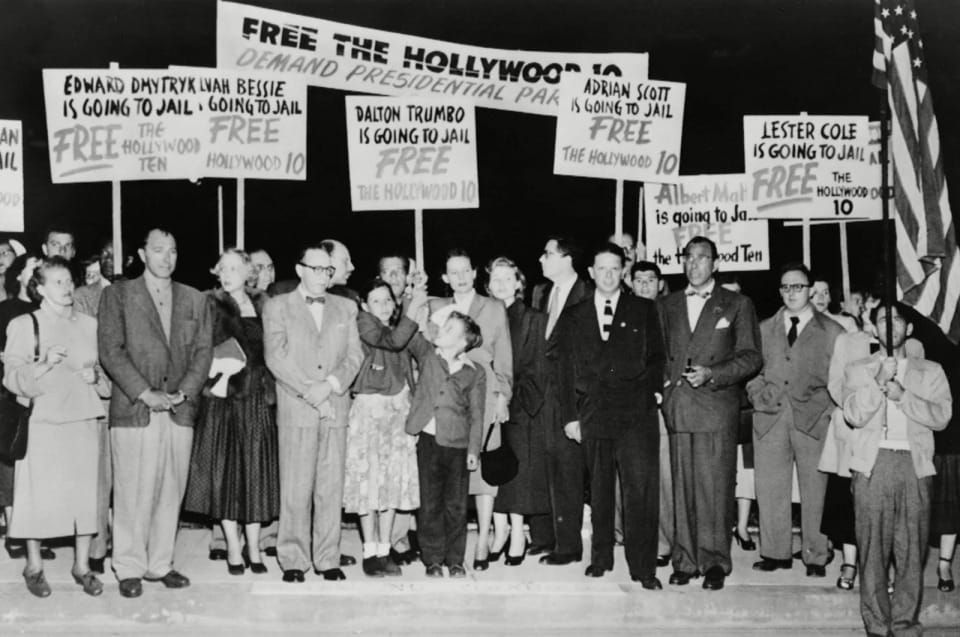
The instrument of this offensive was the House Un-American Activities Committee (HUAC), which in October 1947 summoned a group of Hollywood writers and directors to Washington and asked them whether they were or had ever been members of the Communist Party. Ten of them refused to answer. They were convicted of contempt of Congress and went to prison, and they have been known ever since as the Hollywood Ten. Within weeks the studio heads met at the Waldorf-Astoria in New York and announced they would not employ them, or anyone else who refused to answer.
That announcement is where the blacklist begins—a blacklist that was never a written document. Writers kept working under pen names, or through colleagues who agreed to sign scripts they hadn't written. Some of the films in the Locarno retrospective have only recently had the right name restored to their credits.
What follows is my conversation with Ehsan Khoshbakht.