
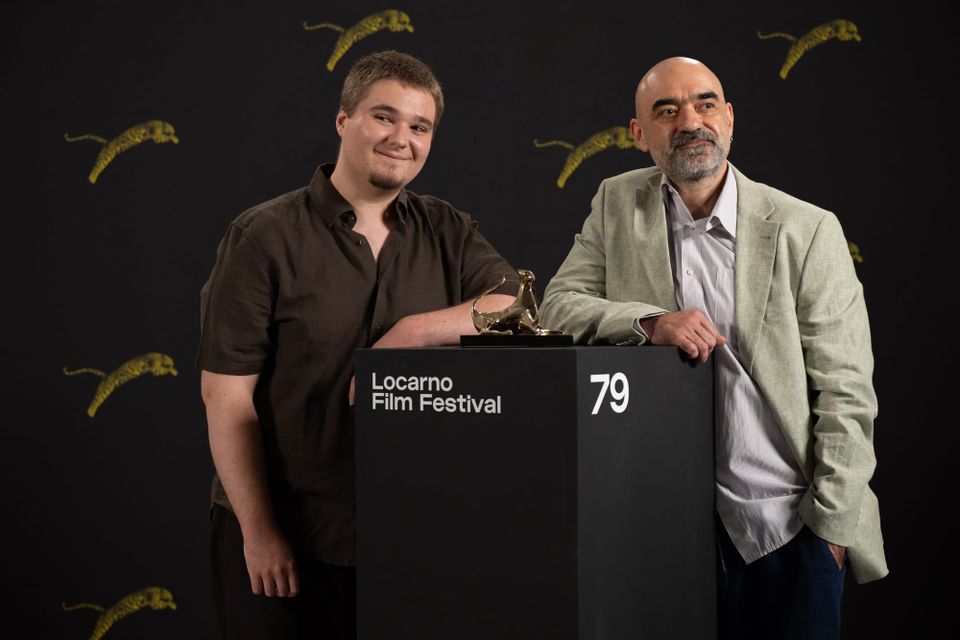
I've spent the past eleven days at the Locarno Film Festival watching films—some entertaining and amusing, others profound and challenging, and of course a few terrible ones I hope to forget—meeting people, attending social events, and so on.
On Saturday I had the opportunity to spend a few minutes with Florin Șerban, the Romanian director of the film that won the main competition's top prize, the Pardo d'oro (Golden Leopard). His Nu e locul tău aici (You Don't Belong Here) sits squarely in the profound and challenging category.
It's the story of Marius Călimănescu (Adrian Văncică), the chief medical officer of a hospital in a small Romanian town, a man raised in the post-communist era and committed to the values of a society built on excellence and merit. A widower, he lives alone with his son Ioan (Teodor Butănescu, who received a special mention for his performance). Ioan is his opposite: lazy, apathetic, without ambition. At night Ioan cycles through town with a gang of masked far-right vigilantes, and during one of their expeditions the group beats an old Roma man to death. When the police begin to suspect his son and the group plans to get the boy out of the country, Marius has to work out what to do to help him, what his wife would have done, and whether he bears some responsibility for what happened.
Here is our conversation.
Florin Șerban, congratulations on the prize. Let me start with the directing style of the film. I found it very theatrical: long shots, very static. Why did you choose this style, and how do you think it serves the story you wanted to tell?
I really don't think I have a style. My visual style and directorial style, if you want, change from one movie to another. If you see my previous movies, they are very different one from another, and I take pride in thinking that I adapt to the story. I don't adapt the stories to my style.
So I think this was the right style for this movie, to let you have like a peek into the life of these people, and to engage you in a very—how should I say—humbling way. It's like I'm talking to the spectator and telling him: I really believe that you're going to stay, and you don't need me to grab you by the neck with fast cuts and make you go "Okay, look here! Look here! Look here! And now you look here! And now you stop! And now you breathe! And now listen to the music, because something bad is going to happen." So I invest a lot in this relationship with the spectator, because the things I'm saying are very soft, are very discreet, and they require a certain patience from the viewer. I think the movie itself selects its viewers.
That's why the premieres—and this premiere especially—are very taxing for me. I know that for the first hour and 12 or 15 minutes I might lose the spectator (Editor's note: the film runs 154 minutes, so this is roughly the halfway mark). But then, if he sticks around, he's going to be happy. He's going to enjoy it, and he's going to be rewarded, you know?