
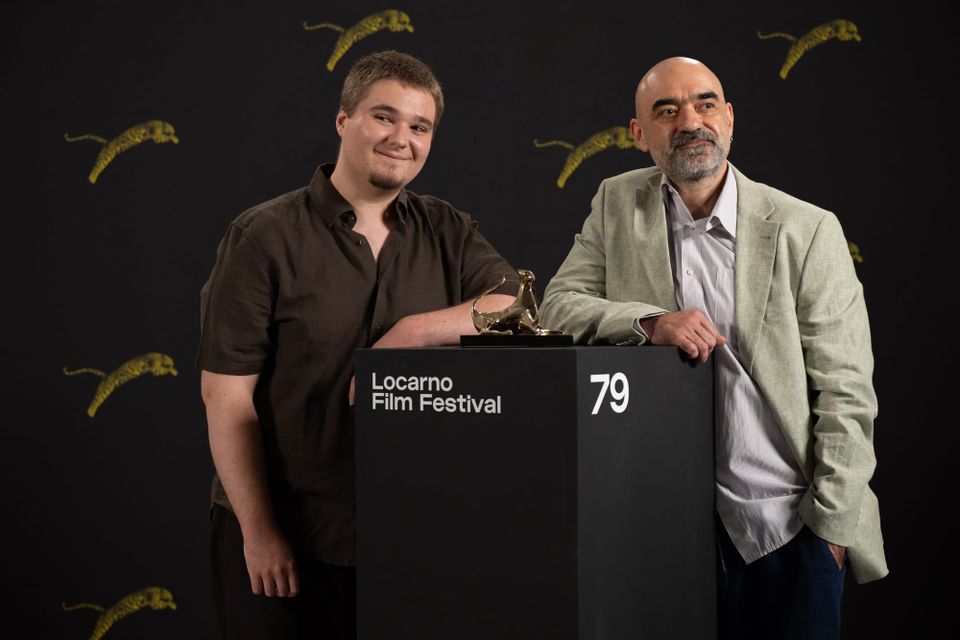
I've spent the past eleven days at the Locarno Film Festival watching films—some entertaining and amusing, others profound and challenging, and of course a few terrible ones I hope to forget—meeting people, attending social events, and so on.
On Saturday I had the opportunity to spend a few minutes with Florin Șerban, the Romanian director of the film that won the main competition's top prize, the Pardo d'oro (Golden Leopard). His Nu e locul tău aici (You Don't Belong Here) sits squarely in the profound and challenging category.
It's the story of Marius Călimănescu (Adrian Văncică), the chief medical officer of a hospital in a small Romanian town, a man raised in the post-communist era and committed to the values of a society built on excellence and merit. A widower, he lives alone with his son Ioan (Teodor Butănescu, who received a special mention for his performance). Ioan is his opposite: lazy, apathetic, without ambition. At night Ioan cycles through town with a gang of masked far-right vigilantes, and during one of their expeditions the group beats an old Roma man to death. When the police begin to suspect his son and the group plans to get the boy out of the country, Marius has to work out what to do to help him, what his wife would have done, and whether he bears some responsibility for what happened.
Here is our conversation.
Florin Șerban, congratulations on the prize. Let me start with the directing style of the film. I found it very theatrical: long shots, very static. Why did you choose this style, and how do you think it serves the story you wanted to tell?
I really don't think I have a style. My visual style and directorial style, if you want, change from one movie to another. If you see my previous movies, they are very different one from another, and I take pride in thinking that I adapt to the story. I don't adapt the stories to my style.
So I think this was the right style for this movie, to let you have like a peek into the life of these people, and to engage you in a very—how should I say—humbling way. It's like I'm talking to the spectator and telling him: I really believe that you're going to stay, and you don't need me to grab you by the neck with fast cuts and make you go "Okay, look here! Look here! Look here! And now you look here! And now you stop! And now you breathe! And now listen to the music, because something bad is going to happen." So I invest a lot in this relationship with the spectator, because the things I'm saying are very soft, are very discreet, and they require a certain patience from the viewer. I think the movie itself selects its viewers.
That's why the premieres—and this premiere especially—are very taxing for me. I know that for the first hour and 12 or 15 minutes I might lose the spectator (Editor's note: the film runs 154 minutes, so this is roughly the halfway mark). But then, if he sticks around, he's going to be happy. He's going to enjoy it, and he's going to be rewarded, you know?
I agree—it's a film that lets the audience settle into the story and into the characters, and understand their struggle, what they are, from every side. What kind of work did you do with the actors? Were there many rehearsals?
Again, it depends on the project. I don't have a style of working with actors: I adapt the style of working with actors to the actor.
Here I have Adrian Văncică, who's a very experienced Romanian actor. He has done it all, you know? He's very famous for comedy in Romania. He walks in the street and everybody goes "Ah!"—because he plays a very funny character in a very popular Romanian comedy series that's been around for 14 years.
So this is a complete change from what he usually does.
Yes, totally, totally. He plays something totally out of his character, his persona, and totally different from the things he usually plays.
So it was one approach with him, and it was another approach with Teo, with Teodor Butănescu, who's a very young actor whom I trained. I have a film school that teaches directing, screenwriting, and acting—mostly acting—so he comes from these classes. It was a different approach with him.
For this particular film, casting Teodor took two years. Finding him took two years. Then he joined the film school, my school, and he was trained as a film actor. And then we did a lot of rehearsals: there were three months of intensive rehearsals with all the actors, and then we got to the set. And on the set we did a lot of takes—at least 20 takes.
With shots that long, I can imagine. And do you discuss the ideas behind the film with them—what it's about, what it's saying?
No, no, no. I don't believe in that. I don't believe in that.
When you talk to a film critic, you talk in a way. When you talk to a film theorist, you talk in another way. When you talk with an actor, you talk in another way—not because they're not educated: some of them are more educated than any critic, and more experienced. But they need to understand exactly what you want from them. And I think an actor does not need to know the whole picture, the whole impact, because it's too much. They have to handle so many things.
So no, I don't talk about patriarchy, about masculinity. I don't talk any theory with the actors. I talk about their emotions, a little bit about the history of the character, but mostly about what happens in the scene. When I go to the rehearsal, I'm very well prepared. I don't just go to the rehearsal and drink coffees with the actors.
Let's talk about the screenplay, because I found it remarkable how you balance so many different registers. We have the small-scale psychology of the father and the son, and then the wider frame: society, the post-communist generations, ambition, violence, racism—a sort of "polite racism."
Exactly, exactly. That's polite racism, yes. It's a very good way to frame it. Polite racism.
What I found very revealing in the film is that the Roma are never treated as people—everyone in the film calls them "gypsies" and talks about them as if they were something external, outside society. So with all this material—the family, the racism, the patriarchy, the masculinity—how do you hold it all together in the screenplay, without losing the human dimension?
This is the thing. When I write a script, I don't put all the subplots in the synopsis, because I write the story first, the outline of the story, and I write the outline of the story for years. And I change the outline, and then I go to the actual script. In the outline I have the main plot. And then, somehow—I really believe in the mystique of the story. I think the main theme attracts the themes that are around, that are floating around, that interest me, that are in the society.
At the beginning it was the story of the mother and the son. And then I realized that the mother is too organically connected to the son. And then I switched to the father, and then the police came. So I think the main theme is kind of a magnet for all the subplots.
And then, I mean, really: sitting at the desk, trying this and trying that. Writing is rewriting. There are many, many drafts to this.
For this movie, for example, nothing was improvised. Nothing at all. But for my next movie a lot is going to be improvised. The actors will barely know the script—I mean, they know what they sign in the contract, so they read the script once, but I don't give them the script at all. We don't do rehearsals, because I want them to be surprised all the time. It's about violence, about this violent dynamic in some families. It's about alcoholism, mostly.
Forgive the naive question, but for you, who is guilty in this film? The father, the son?
Nobody. Nobody. It's nobody and everybody. But nobody. They're trying their best. They just don't know how to do better.
And I don't think it's a naive question. I'm not thinking about these characters in terms of good or bad, or who did wrong and who did right. I think they are all doing their best, given the environment and the history and the personal history. I think they are complicated times, and I think what's lacking the most in our times is not necessarily information or education. I think it's the lack of empathy, and the lack of love.
That's how I saw the film too: these characters try to do their best.
And it doesn't work.
Yes, and they fail. There's a sort of fatalism: even if we try our best, are we doomed?
The main character is a tragic character. It's like in all the tragedies of this world, like all the Greek tragedies: no matter how well you do, you're damned. You're doomed. Because somebody up there doesn't love you, and you need to fail.
And I think it's a tragedy that surrounds a lot of people of my generation, men and women—my generation, your generation, in Europe. Because the values are shifting so much that many times we just don't find our place in the world anymore, and we need to be smart enough to find a different place.
In Greek tragedy we have the gods; here we have society. And I think that this difference emerges in the final scene at the school. (Editor's note, spoilers ahead: the father returns to his old high school for a class reunion. His former classmates list their accomplishments one by one; when his turn comes he lies about his son, then breaks down and walks out.)
For me, that is the scene where we perceive that something has been broken—where we understand that he has grown up in a society that gave him certain expectations, a certain idea of himself. Was that the intent of this scene?
Yes, totally. And you got it right. In the Greek tragedies there were gods. Here it's society.
And I think for this type of character—sort of a Faustian character, you know, like him, who wants to conquer everything, to make the world a bigger place, a better place, to be excellent, to excel in everything—the worst that can happen is to flinch. To have second thoughts. To have fear. And I think this is what society can bring to this type of people: fear. And then you're doomed. You know what I'm saying?
I mean, if you're a Faustian character, don't doubt yourself. Just go all the way, you know? But nobody is really a Faustian character. That's in Faust, that's in Goethe, that's 250 years ago. Nobody is like this. We are people, we are not characters. We have doubts, we have fears. We are angels and we are demons at the same time.