
I don't know when and where you, my dear reader, will enjoy this newsletter. But in Western Europe, at the end of June 2026 — when and where I'm writing these words — the temperatures are very high, breaking many historical records.
We have many direct victims of this heatwave, people whose deaths are directly attributed or linked to the extreme heat: these are tragic stories, small children left in a car or people who drowned. But the real impact is more widespread and less obvious, and it is measured by excess deaths — a statistic that compares the number of deaths during a heatwave with the "normal background" of deaths. And a preliminary analysis — I'm writing in the middle of this heatwave — has put the toll at at least 1,000 deaths in France alone.
Were those deaths preventable? I suspect this is the only question that gets the same answer from nearly everybody: climate activists, concerned scientists, public-health and civil-protection officials, the adaptation-first crowd who would rather we cope than cut emissions, ordinary skeptics, and even the self-styled deniers of the human origin of climate change. They all answer "yes," albeit for incompatible reasons — only the full deniers are left out, those who deny there is any global warming at all and insist that summer is always this hot.
Before we look at the different reasons why these deaths are, in one way or another, preventable, let's pause on these "full deniers." I'm not referring to people who don't believe that human-made emissions are altering the climate and who think global warming is due to other factors like the sun, volcanoes and so on; nor am I referring to people who believe it's not such a big problem after all and that we can keep polluting as ever. I'm speaking of people who claim that global temperatures are not increasing, and that heatwaves like this one had already happened in the past. To substantiate this thesis they offer up some memories of incredibly hot summers, generally in the seventies or the eighties; some newspaper front pages with apocalyptic headlines; in some cases, old TV weather forecasts, useful to show not only that we already had elevated temperatures, but also that in the good old days they were greeted without alarmist tones. In some cases these relics are doctored — nowadays it's trivial with generative AI — but even when they're authentic, the comparison is nonsensical. First of all, we cannot directly compare different sources, like the value appraised with due diligence by an official weather service and the thermometer used by a journalist to justify a headline in the slow news season.
There is another problem: the shifting baseline. The phenomenon is similar to the one captured by the (zoologically dubious but rhetorically perfect) image of the boiling frog: drop a frog into hot water and it leaps out; place it in cool water and raise the temperature slowly enough, and it never registers the moment things turned lethal. We are this hypothetical boiling frog not only because the warming is gradual, but also because each of us takes the climate we grew up with as the natural state of things and measures every later summer against that, not against a fixed reference. We don't remember the stable, sunny weather of the summers governed by the Azores High that dominated until — sometime in the eighties — the African anticyclone began to muscle in, dragging air that is several degrees hotter than the identical pattern would have delivered fifty years ago. But we don't compare the present with fifty years ago, because in these fifty years we have shifted the baseline many times.
So it's possible, and perhaps even easy, for deniers to say that this summer is nothing special, that we've already had hot — maybe hotter — summers. To rebut them we have to start talking about the Wet Bulb Globe Temperature index, about medians and averages and anomalies relative to a reference climate, about return periods and exceedance probabilities and the multiplier by which a given heat extreme has become more likely (for this June, attribution scientists put it at tens to hundreds of times more likely than in 2003, and virtually impossible fifty years ago). And this is a problem, because we perceive whether it's warm or cold; we do not perceive a linear regression.
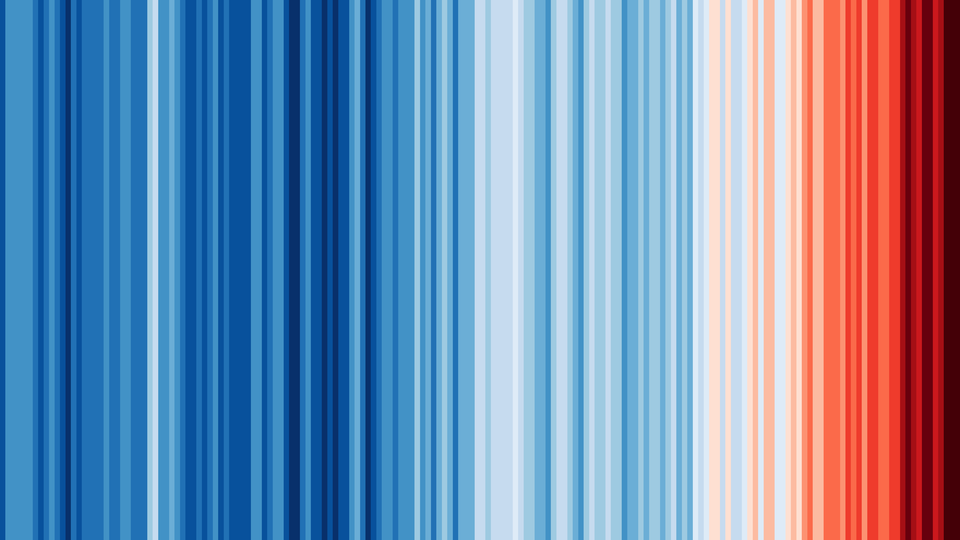
But we are lucky, because we do have a solution: warming stripes. Conceived in 2018 by climate scientist Ed Hawkins, of the University of Reading, they reduce more than a century of temperature data to a single barcode: one vertical band per year, running from deep blue for the coldest years to dark red for the hottest, with no axes, no numbers, no labels. Their effectiveness rests on a kind of visual force — they work the way certain color-field paintings work — and on their radical simplicity. You look, and the warming is self-evident; the argument is over before it begins. Yes, those strengths are also their limits: we cannot directly compare local versions of the stripes, because the colors have different reference points, and once you understand the mechanism, you can try to manipulate it by picking a location and period where the trend is less obvious.