
I have been following Massimo Pigliucci's work for a long time and I consider his thoughts very valuable. Indeed, we share the same interests and the same approach: philosophy, science, and rationality with a non-dogmatic flavour. What differs is the role (not necessarily the commitment): he's a professor and writes books; I am "only" a journalist and a newsletter author, which means I write short and trivial articles — sometimes, like this one, about his work. What also differs is the order in which we came to those interests. I started out studying philosophy and moved later toward science, ending up as a science journalist. He started out as an evolutionary biologist and became a philosopher afterwards.
Then, in 2017, he published How to Be a Stoic, and he surprised me. Philosophy, as I had learned it, was an academic discipline — or, more accurately, a bundle of academic disciplines. It was not something a layperson could go to in order to find out how to improve their life. That book showed me that I was wrong.
So I settled into a division that seemed clean enough. There is a philosophy that analyzes and challenges our concepts and our thinking — and asks questions like what knowledge is and how we might get it — and does so as a specific and sophisticated discipline. And there is a philosophy that helps you live. Two different creatures with a common ancestor and some traits in common, but that live in different territories.
Now he has proved me wrong a second time. How to Be a (Happy) Skeptic takes an epistemological tradition and shows its relevance for a philosophy of life. Because Stoicism is a "complete" system, with physics, logic, and ethics — but the most relevant part (at least for us, but also in the Hellenistic period) is the ethics. Skepticism is the other way around: the core is the logic, i.e. the answers to the questions of how I must think and what I can know.

First of all, some housekeeping on the terminology, because the modern meaning of "skepticism" is quite different from the ancient one, and quite derogatory. Today a skeptic is someone who simply doesn't believe: the climate skeptic doesn't believe in human-made global warming despite scientific evidence, the vaccine skeptic doesn't believe in the effectiveness of vaccines, again despite scientific evidence, and so on. But the Greek skeptikos meant inquirer. A skeptic was not someone who had decided in advance to withhold assent, but someone who kept looking, on the assumption that the answers already in hand may be useful but are not the final ones.
Pigliucci wants that word back, and he wants it for a specific reason. He had practiced and recommended Stoicism, but as we said Stoicism is a system, and like any system it presents a risk. This risk is named by Simone de Beauvoir in her memoirs, in a passage Pigliucci quotes: that from a philosophical system people derive an obsessional attitude, endowing their provisional patterns with universal reach. The risk is to stop asking whether it is right.
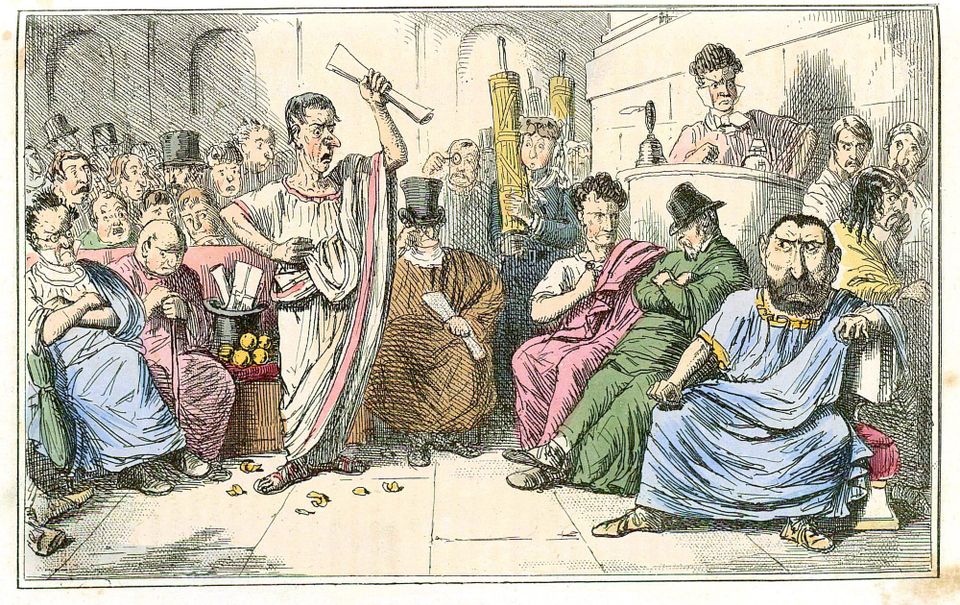
Cicero is the proposed remedy. He belonged to the Academy, the school founded by Plato that, by Cicero's day, had long since taken a skeptical turn. Cicero was steeped in Stoicism and took most of his ethics from it — the histories of philosophy that I had studied labeled him as an eclectic, very influential but not innovative — yet he never signed up.
That explains why skepticism. But why Cicero? Because he was not perfect — what we might call a sage — and Pigliucci says so directly: that is what makes him a better model than Buddha, Jesus, or the out-of-reach Epictetus. He was courageous at some moments and timid at others, generous and occasionally petty, brilliant and capable of serious blunders. He believed in the priority of reason over emotion and fell apart when his daughter Tullia died (this part really touched me). He is a man visibly doing his best, which is the thing any of us can do. Maybe the political failures deserved more attention than the personal ones, because they are the ones that speak most directly to our own situation — Cicero lived in the last years of the Roman Republic and was murdered on the order of Mark Antony. Pigliucci notes in passing that Cicero was «completely blind» to the murder of the Gracchi as the turning point it was, the moment when class conflict began to slide into violence and to undermine the republic from within.
How to Be a (Happy) Skeptic alternates chapters with biographical interludes, so the ideas and the life keep resonating with each other. The whole is organized around a set of questions taken from Cicero's own works: how do we know anything, what matters most, how to be a good citizen, how to tell fact from fiction, how to build a just society, how to be a good friend, how to grieve, how to age, how to face pain and death.

So what does the skeptical attitude actually change in Stoicism? Less and more than we may expect, and the reason is structural. Stoic ethics is grounded in human nature: we are social animals capable of reason, and living well means living in accordance with that. Skepticism is, as David Hume would put it eighteen centuries later, the discipline of proportioning belief to the available evidence. Point it at claims about human nature and the ethical foundation inherits all their uncertainty — "live according to nature" becomes "live according to our current best account of nature". It's a weaker and more provisional starting point, but maybe — if we succeed in governing this instability — a better one for navigating complex and nuanced situations like those that challenged Cicero in the first century before the common era (and us today, of course).
As a reader of Pigliucci's previous books on Stoicism, I found the epistemology chapters the most interesting. Here skepticism does real work: it generates Carneades's evaluation tree and the demarcation criteria to tell science from pseudoscience, and it is what allows Cicero to dismantle divination without dismantling the possibility of knowledge. The other chapters pick up the main aspects of Stoic ethics, framed of course in the very interesting and relevant life and works of Cicero. But I wondered if the skeptical turn promised by the book doesn't become a simple courtesy formula — "I might be wrong about this, hold it lightly".
The ethical conclusions, despite being provisional, are the same that a dogmatic Stoic would reach. Perhaps it's inevitable: as we said, a skeptic is not a person who doesn't believe, but a person who considers levels of plausibility (the Greek word pithanon, which Cicero translated into Latin as probabilis). And Stoic ethics is undiverted, if not thoroughly explored — the two highest levels of pithanon, the lower ones being merely apparently true and convincingly true.

But in How to Be a (Happy) Skeptic there are some claims that are not undiverted, and where I would have been more cautious.
The first is human exceptionalism, the idea that there is a leap between humans and the other animals. Pigliucci writes that «we humans (and no other animals) have the concept of justice». Of course only humans have written books about justice — but a small part of them has done so, and all in the last part of the existence of Homo sapiens. Pigliucci admits (and indeed it is a central point in the human nature analysis) that other species act in just ways, so I would not dismiss the idea that they could have a concept of justice.
The second is social media. The book treats their effect as settled and negative, resting on thinner evidence than it uses elsewhere. The research is contested, and it does not rule out that mediated contact sustains relationships that would otherwise not exist at all.
The third is the postmodern attack on science. "Science is a social construction" is offered as a specimen of pseudophilosophy, and split in two: trivially true if it means science is done by humans, obviously false if it means science is arbitrary. That's a false dilemma fallacy, which leaves out the interesting middle: how the values and biases inside the social organizations that produce it impact scientific research.

Those are minor issues, worth pointing out but marginal to the core of the book and to the "skeptical Stoicism" Pigliucci proposes. As I said, the ground here is "live according to our current best account of nature", the skeptical variant of "live according to nature". And this best account states that we are social animals capable of reason.
Is that knowledge robust and accurate enough to sustain a Stoic-like ethics? I am not sure. I see two problems, arriving from two different directions.
Upward, it is not so simple to accommodate every aspect of ourselves inside this nature of social and rational animals. Being social gives us a great deal — reciprocity, cooperation, an aversion to unfairness that we share with other primates. But it also gives us in-group preference, deference to hierarchy, and a readiness to divide the world into us and them. Those are just as natural, and just as well documented. So when and how should we use reason to correct our behaviour, rather than to follow it?
Pigliucci has a tool for this question, and it is one of the best things in the book. In chapter three he presents Panaetius's four personae, glossed in modern terms: the nature we share as human beings, the one shaped by our genetics and early development, the circumstances we happen to be born into, and the direction we choose for ourselves. Four layers, and the last one is ours to decide.
But that only helps to better understand the problem, not to solve it. Take gender roles. Across a great many cultures we find men and women assigned different tasks, and different expectations about their behaviour. There are biological differences between the sexes — but how far must we adapt to them, and how far should we emphasize them? And for the social part, the questions multiply. Do we have to change our culture and our traditions in order to make them more fair? Or is it enough to guarantee emancipation to the individuals who do not fit the roles they were handed? Or, on the contrary, should we help those people to adapt to their roles and accept them? All three answers have been given, all three by people appealing to human nature, and being rational animals does not settle which is right. Reason is just as good at organizing a hierarchy efficiently as at questioning whether it should exist.
The same goes for prejudice: preferring our own group is natural for a social animal, and we correct it anyway. What tells us to correct these things is not our nature and not our rationality. It is a judgment about fairness, and about the cost paid by the people those arrangements constrain. Which means we need skills that go beyond being a social and rational animal.
The second problem comes from the opposite direction. Ethics is grounded in human nature, but human nature is quite diverse.
Some of these differences are physical, and this has little relevance for the foundation of ethics — though it is important for its application, in terms of discrimination and of guaranteeing accessibility to people with non-standard bodies. But other differences are mental. And here the discourse starts to be interesting. Autism and ADHD are the clearest examples: they are different ways of thinking, of attending, of processing what comes in, including the relationship with other people. Whether that constitutes a disorder or a physiological variation is a debated question, and the fact that it is debated is itself the point: human nature is a weak guide. And the diagnosed cases are only where the question is sharpest. Human beings vary continuously in how much company they want, in how they attend, in how they feel.
So when we say that we are social animals capable of reason, we are describing a statistical artifact that captures a majority — and often a sizable minority — but not all members. Living in accordance with that nature may mean something quite different from one person to the next, and an ethics that reads its norms off the average risks not respecting all people.
I am not saying that ethics should be dissolved into a description of individual preferences and moral intuitions. What I am saying is that a description of what most people are like cannot, on its own, tell us which departures from it are problems to be fixed and which are simply other ways of being human.
In a footnote Pigliucci partially acknowledges this aspect, citing the case of psychopaths, who do not undermine the prosocial normality of human nature because they are «by definition, mentally defective human beings». And psychopaths indeed are so. But there are many shades of prosocial attitude, and many of them are physiological variations of the human mind.
So human nature does give us a useful starting point. But it is a starting point that is also a little unsteady and shaky, and we must acknowledge that, in order to avoid the risk of imposing unsustained norms and of failing to respect individual characteristics. After all, that is the whole idea of embracing skepticism, as stated in the introduction. So in addition to human nature we need other tools, like the concepts of harm, consent, and autonomy.

I am not sure whether these difficulties are really a criticism of Pigliucci's book, or the coherent consequence that ethics is not a set of theorems but a question of practical wisdom (phronesis), as Pigliucci has pointed out on many occasions. But phronesis is a skill, not content. It still has to be trained on something, and the question is what expertise and what concepts we use to train it. I am not sure that "human nature" is the key tool: a useful thing to bear in mind, but pointless alone.
Not because our nature is irrelevant — it tells us why we care about each other at all, and it is where reciprocity and the sense of unfairness come from — but because it is too coarse to decide the cases that actually trouble us. Whether a set of gender roles should be dismantled or merely opened up, whether a way of being unsocial is a deficit or a variation: our nature as social and rational animals does not settle these; harm, consent, autonomy, fairness, and care are perhaps more useful instruments.
And this, in the end, is what the skeptical turn was supposed to deliver. A Stoicism held provisionally is not one that repeats the same conclusions with a disclaimer attached. It is one where the foundation is genuinely open to revision, including revision that moves the center of gravity away from nature and toward the individuals the ethics is meant to help.

Pigliucci has proved me wrong twice, and I am happy about this. What I found is an excellent introduction to Cicero, precious tools for navigating uncertainty, and a foundation I do not think will hold in the shape it is given. That is more than most books offer, and it is more useful than agreement. The skeptical Academy taught by arguing both sides of a question.